
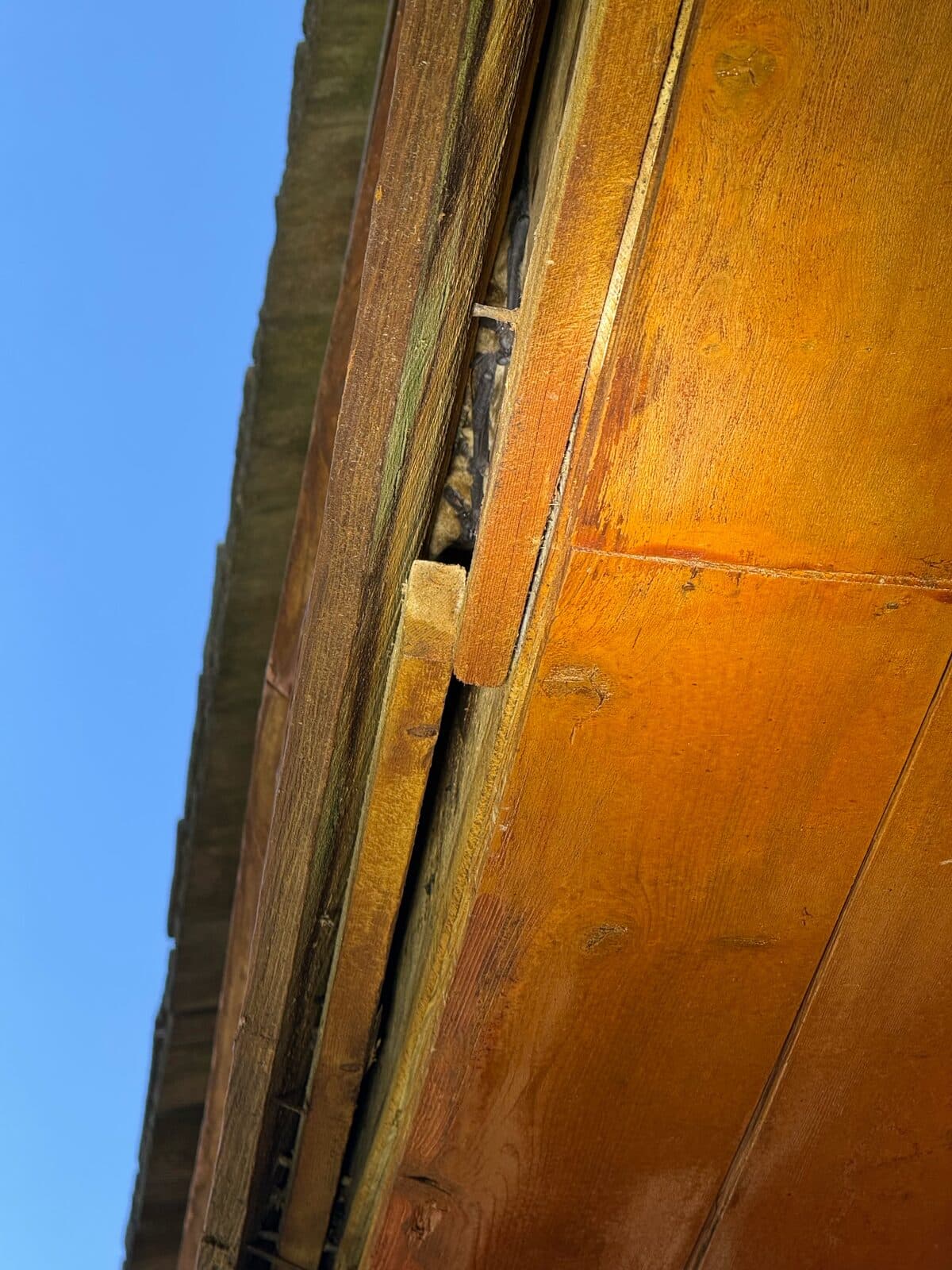
Fly-in vs roost: what the signs mean
A bat that darts in when the door is up and leaves when you open it again is usually hunting insects drawn to the light, or a young bat that got disoriented. UC IPM notes that bats found indoors are often lost young whose only goal is to escape. An established garage roost looks different: droppings (guano) piled under the same eave, header or ridge night after night; staining or an ammonia smell in a garage attic; dusk fly-outs from a specific gap while the door is closed. Guano crushes easily and shows shiny insect fragments—unlike mouse droppings. If you only see one bat and no pile of droppings, treat it as a fly-in first: isolate the space, open an exterior door or window, and let it leave. If droppings keep appearing under the same gap, schedule an inspection.
Where bats get into Southern California garages
The most common garage entries we map are the bottom seal and side weatherstripping on roll-up or tilt-up doors (a gap of about 1/4 inch is enough), the header and jamb transitions where the track meets the wall, unscreened gable or eave vents on detached garages, open tile ends and fascia-to-stucco joints where a garage ties into the house roof, and attic hatches or pull-down stairs that open into a living attic. Detached garages and workshops with exposed rafters also attract night-roosting pallid bats under open porch-style covers. UC IPM lists cracks around doors, vents and loose boards among the usual building entries, and the same geometry applies to garage shells.
If a bat was in the garage overnight
California public health agencies treat a bat found in a room where someone was asleep, or where a young child or pet was present and contact cannot be ruled out, as a possible rabies exposure—even without a known bite. Do not release or dispose of the bat. Close the door, keep people and pets out, and call your city or county animal services so the bat can be tested when possible. Then call your county public health communicable-disease line. San Bernardino County Public Health's Communicable Disease Section is 1-800-722-4794 weekdays (1-800-472-2376 after hours); L.A. County and Orange County have their own veterinary public health numbers. Wash any wound with soap and water and seek medical care. CDPH's provisional county tables show bats remain the primary rabies carriers reported in California.
How garage exclusion works (and when to wait)
UC IPM advises against excluding a colony while flightless young may be present, usually May through September in California—parents shut out means pups starve inside and create odor and fly problems. We watch the garage at dusk to confirm the active exit, fit a one-way device (netting or tube) so bats can leave but not return, and seal the other gaps with weatherstripping, custom inserts, screened vents or bird stops matched to the material. Leave one-way devices in place about seven days per UC IPM before permanent closure. No pesticides or chemical bat repellents are registered in California. Spray foam in a door jamb or tile arch shrinks, traps bats and is hard to reverse—we do not use it. After exclusion, replace worn door seals and keep the attic hatch gasketed so the house side stays closed.
Detached garages, workshops and ADUs
Detached structures often get skipped when someone only thinks about the main attic. We inspect them when droppings, staining or dusk fly-outs point beyond the house—especially on Inland Empire and foothill lots with barns, workshops and ADUs. A colony in a detached garage can later move into the house if the structures share a breezeway, patio cover or continuous fascia. CDFW treats bats as protected nongame mammals: killing them or sealing them inside is not a legal DIY fix. Animal services generally will not remove a healthy colony from a garage; that is a private exclusion job after any exposure risk is handled.
Ready for help in Los Angeles, San Diego, or elsewhere in Southern California? Start with bat removal or an attic inspection.
Sources
- UC IPM Pest Notes: Bats (1/4-inch gaps, exclusion timing, one-way devices)
- UC IPM: Bats (home and landscape)
- CDFW: Human-Wildlife Conflicts, Bats
- Bat Conservation International: Bats in Homes & Buildings
- CDC: Preventing Rabies from Bats
- CDPH: Rabies
- CDPH: Reported Animal Rabies by County & Species, 2026 (provisional)
- San Bernardino County: Bat safety education—protect yourself and prevent rabies (Sept. 2024)
- California Fish and Game Code §4150 (nongame mammals)