
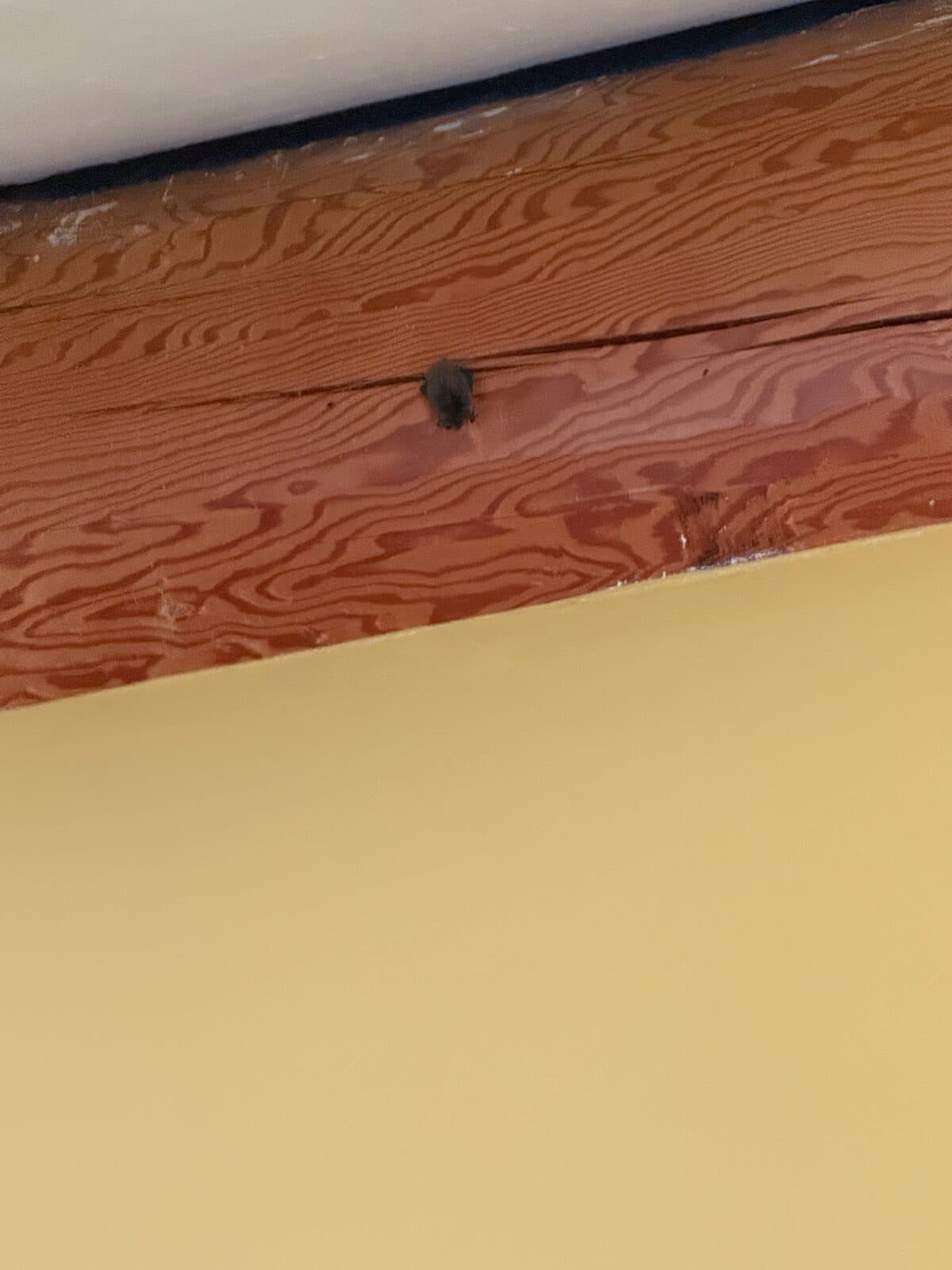
Night roosts and day roosts are different things
Bats use different kinds of roosts for different jobs. The BC Community Bat Project describes day roosts as the places bats sleep and live during the day, usually enclosed spaces such as attics, sheds and siding, with noise, smell or guano that make them fairly obvious. Night roosts are where bats rest between foraging bouts to digest before flying again, and they're often open spaces: under bridges, archways above doors, covered patios and carports. The Devil's Gate bat survey prepared for LA County Public Works uses the same definitions, describing night roosts as temporary resting spots for digesting food, often next to good foraging habitat. The practical difference for a homeowner is timing: a day roost holds bats from dawn to dusk, while a night roost is usually empty by morning, which is when you find the mess.
Signs that it's a night roost
The BC Community Bat Project says residents rarely see bats at night roosts, but find droppings every morning. Typical signs are a small, fresh pile of droppings in the same spot each day, below a beam, a light fixture, a porch ceiling corner or the top of a column; insect wings and legs mixed in; and stains or rub marks on the wood above. UC IPM describes bat droppings as crumbling easily and containing shiny bits of insect parts, never white and chalky like bird droppings. Insect remains are a strong clue: Contra Costa County says bats roosting on porches and eaves are usually pallid bats that come at night to roost and eat their meal, and that insect body parts are often found below the roost. You may also notice that the droppings stop for a while in the coldest months and come back in spring.
Which California bats use porches and patios
The species most associated with porch night roosts in California is the pallid bat, a California Species of Special Concern. CDFW's California Wildlife Habitat Relationships account says pallid bats day-roost in caves, crevices and mines and occasionally in hollow trees and buildings, that night roosts may be in more open sites such as porches and open buildings, and that they may carry large prey to a perch or night roost to eat it. A 2016 conservation assessment for the pallid bat in Oregon and Washington explains why that leaves a trail: the bats let the inedible parts of their prey fall to the ground, which is how researchers find night roosts, and they favor spots that are easy to fly into but sheltered from wind and rain, and warmer than the open air. Pallid bats aren't the only ones. The Devil's Gate survey in Pasadena recorded a myotis night-roosting under the Oak Grove Drive bridge, and found guano below both that bridge and the I-210 bridge over the Arroyo, which the surveyors said were likely used mainly as night roosts. See our California bat species guide for more on who's who.
When night roosts are busiest
Night roost use changes through the year. The pallid bat conservation assessment says night roosts were used least by nursing females and heavily by all bats in spring and fall, with up to 75% of the night spent at the night roost in some studies, and that bats tended to arrive early in the evening and often came and left in groups. In Southern California, where winters are mild, that usually means droppings show up in spring, may ease off in midsummer and pick up again in fall. Because a night roost is used at night and the bats leave before dawn, the timing rules that apply to evicting a colony are different: there are no flightless pups living on an open porch beam. The pup-season rule still applies to any real day roost you find, though. UC IPM says flightless young may be present, usually from May through September in California, and advises against excluding a colony then.
Check whether you also have a colony
A night roost on its own isn't a sign of bats living in the house, but bats that night-roost on your porch could be day-roosting somewhere nearby, sometimes in the same building. A few checks help sort it out. Watch the outside of the house from about half an hour before sunset until it's dark and see whether bats come out of the eaves, vents, siding or roof. Look for droppings stuck to walls or piled on the ground below a gap, rather than only under the porch ceiling. Check the attic or garage for droppings, staining or an ammonia smell, and listen for scratching or squeaking in walls at dusk and dawn. UC IPM says bats can get through gaps as small as about 1/4 inch and that common entry points include openings beneath eaves, around chimneys and vents, near loose boards and beneath roof caps. If you find any of these, our signs of bats guide and signs-of-bats checklist walk through what to look for, and a colony needs one-way exclusion, not porch deterrents.
Deterrents that work, and ones that don't
Because bats use a night roost only at night, the simplest deterrents are physical changes made during the day while the bats are away. Contra Costa County suggests covering the spot with smooth, tight-fitting hard plastic such as Plexiglas, so bats can't crawl under it or cling to it. The BC Community Bat Project lists similar options: leaving the area brightly lit, a fan set on a timer to blow across the wall where bats hang, mylar balloons or foil strips that move in the breeze, and slippery sheeting on the surface they cling to. Sealing or boxing in the rough corner or beam pocket where they hang can also work. What not to use: UC IPM says no pesticides or chemical repellents are registered in California for bats, and that ultrasonic devices haven't been shown to work. Skip mothballs and sprays, which some older guides suggest; they aren't approved for bats and they put the chemicals where your family and pets live. Never spray, swat or try to catch the bats. Bats are protected nongame mammals under California Fish and Game Code section 4150, and CDFW's bat page covers how to handle conflicts without harming them.
Cleaning up droppings safely
A small, fresh pile on a porch is a different job from an attic full of guano, but the same basic precautions apply. UC IPM says histoplasmosis, a fungal infection linked to bat and bird droppings, has rarely been reported in California, but recommends that anyone cleaning up droppings wear protective gear including a respirator that filters particles as small as 2 micrometers, and notes that wetting the droppings can help keep dust down. The CDC says histoplasmosis spreads by breathing in fungal spores from soil or droppings. For a porch, wear disposable gloves and a particulate respirator, mist the droppings lightly with water, wipe or scoop them into a bag, wash the surface and your hands, and don't dry-sweep or use a leaf blower. If droppings land on a walkway or patio table every morning, the BC Community Bat Project suggests putting a plant pot where they fall, or a shelf or small gutter below the roost, to catch them. If droppings are piling up indoors, in an attic or in a wall, that's a sign of a day roost and calls for professional cleanup after exclusion.
Never touch the bats
Even a bat that seems calm on a porch beam should be left alone. The CDC says not all bats carry rabies, but bats are the most commonly reported rabid animals in the U.S., and bat bites can be so tiny you may not know you were bitten, so any possible contact should be reported to your health department. The CDC lists bats that are active during the day, found on the ground or unable to fly as possible signs of rabies, and says to keep your distance and contact animal control or your local public health department. L.A. County Veterinary Public Health publishes bat and rabies information for most of the county; Pasadena and Long Beach have their own city health departments. Keep pets inside at dusk if bats are using the porch, and make sure their rabies vaccinations are current. If you find a bat on the porch floor or ground during the day, follow our found a bat outside guide: cover it with a box or bucket if you can do it safely without touching it, keep people and pets away, and call your local animal control. If anyone may have touched it, wash the area with soap and water and get medical advice the same day.
Ready for help in Los Angeles, San Diego, or elsewhere in Southern California? Start with bat removal or an attic inspection.
Sources
- BC Community Bat Project: Got Bats? FAQs (day vs. night roosts, night-roost deterrents)
- Contra Costa County: Bats (2017)
- CDFW California Wildlife Habitat Relationships: Pallid bat life history account
- Gervais (2016), Conservation Assessment for the Pallid Bat in Oregon and Washington (USDA Forest Service / BLM ISSSSP)
- LA County Public Works: Devil's Gate Bat Pre-Construction Survey Report (Fall 2018)
- UC IPM Pest Notes: Bats (droppings, entry points, repellents, histoplasmosis)
- CDFW: Species of Special Concern, Mammals
- CDFW: Human-Wildlife Conflicts, Bats
- California Fish and Game Code §4150 (nongame mammals)
- CDC: Preventing Rabies from Bats
- CDC: About Histoplasmosis
- L.A. County Public Health, Veterinary Public Health: About Bats
- Bat Conservation International: Bats in Homes & Buildings