
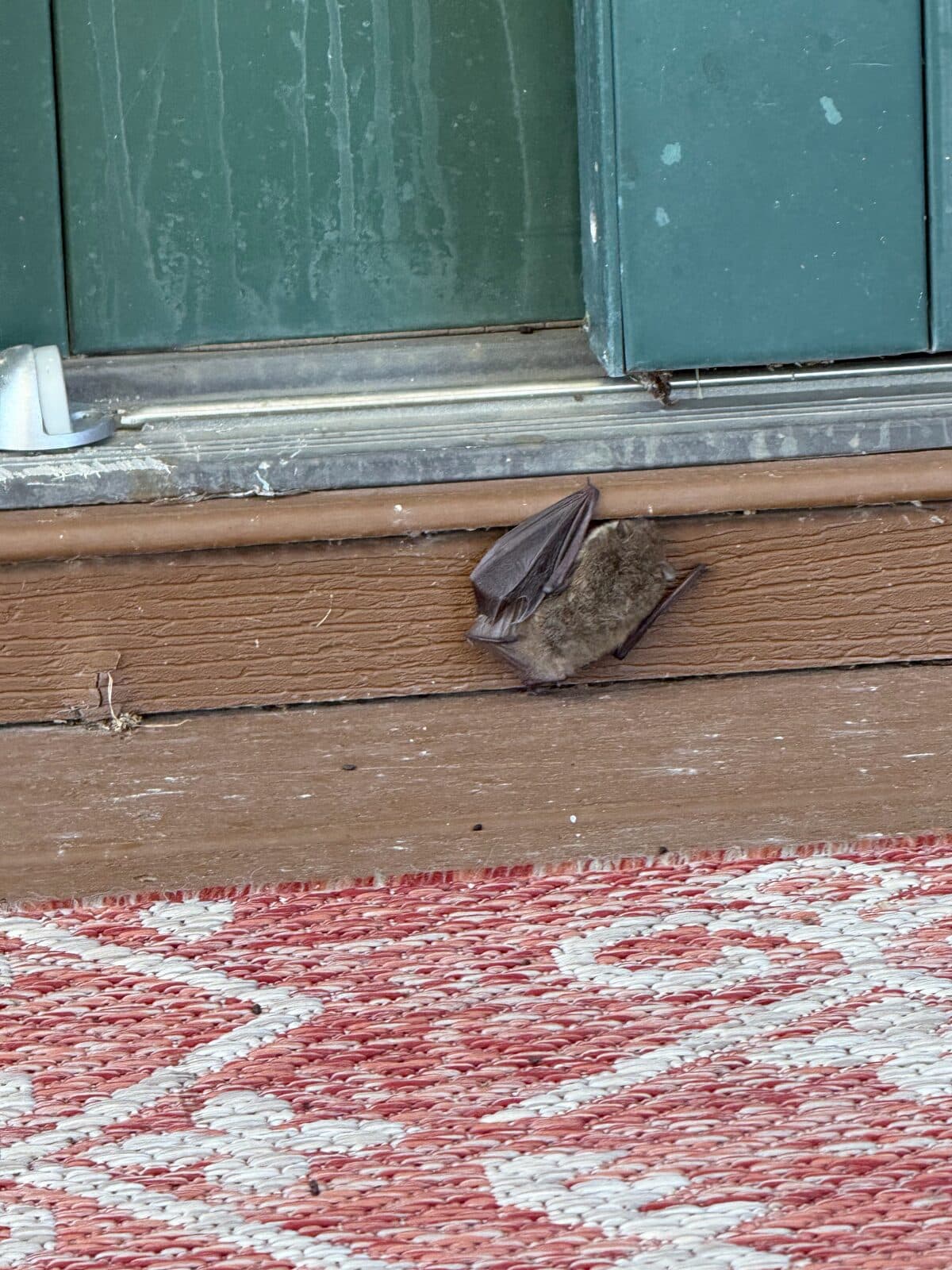
First: don't touch it, and keep kids and pets away
Every agency agrees on the first step. L.A. County Veterinary Public Health says not to touch a bat on the ground with bare hands and to keep people and pets away from it. CDFW says plainly: do not touch live bats. After Long Beach's first rabid bat since 2014, the city's October 2026 advisory told residents who find a bat in or outside the home to cover it with a box and call Long Beach Animal Care Services. Bring the dog inside, keep the cat in, and tell children to stay back and get an adult. OC Animal Care's bat flyer says to teach family members never to touch a bat and to alert an adult if they find one on the ground. A grounded bat that is picked up or poked may bite in self-defense, and most U.S. rabies deaths are linked to bats, according to the CDC.
Is it resting or sick? What to look for
Not every bat you see in the daytime is a problem. CDFW says seeing one or two bats during the day isn't usually a cause for concern, because bats sometimes leave the roost to eat and drink. A bat simply roosting outdoors, on a patio umbrella, a stucco wall or behind a sign, poses no safety risk if it's left undisturbed. The warning signs are different. The CDC lists a bat that is active during the day, found somewhere unusual such as on the ground, unable to fly or easy to approach, or that has made contact with a person. The Long Beach Health Department's list is similar: bats active during the day, on the ground or unable to fly may be sick. L.A. County puts it this way: a bat active in daylight is most likely disoriented and may be sick. None of these signs can confirm rabies or rule it out; only a lab test can.
A bat on the ground: cover it and call animal control
L.A. County's advice for a bat found on the ground: if it's moving and appears healthy, leave it alone. If it seems sick and is barely moving, call your local animal control agency and gently cover the bat with a container that has air holes until they arrive, making sure no one touches it. OC Animal Care's flyer gives the same instruction for a bat outside that is sick, not moving or dead: place a box or bucket over it and call your local animal control to collect it for testing. Use a box, bucket or plastic tub, and wear thick leather gloves if you have them. The county says it is illegal to keep, injure or kill bats and asks residents not to try to nurse a bat themselves. Don't put it in a shoebox in the garage overnight, give it water or try to toss it into the air to "help it fly."
If anyone touched it or a pet got to it
If a person touched the bat or was bitten or scratched, L.A. County says to treat it as a possible rabies exposure: put a box over the bat and contact both public health and your local animal control so the bat can be tested. The CDC says to wash a bite or scratch with soap and water and get medical help right away, and to see a healthcare professional urgently if bat saliva may have gotten into the eyes, nose, mouth or an open wound. L.A. County says rabies post-exposure treatment, if it's needed, should start as soon as possible, ideally within one to three days. If a dog or cat had the bat in its mouth, call your veterinarian and animal control. The county says a pet with a likely exposure is quarantined for 30 days if it's vaccinated against rabies and for six months if it isn't, which is a strong reason to keep even indoor cats vaccinated. Testing the bat can rule out an exposure, which is why it shouldn't be released or thrown away.
What about a dead bat?
Don't touch it with bare hands either way. CDFW's general guidance is that, if you find a dead bat, you can put on gloves, place it in a plastic bag and throw the bag and gloves in the trash. In Southern California, though, what matters is whether anyone might have touched it. OC Animal Care says to cover a bat outside that is sick, not moving or dead and call animal control to collect it for testing. L.A. County says any bat that may have had contact with a person or pet should be tested. So if a child, a dog or a cat could have touched the bat, or you aren't sure, call animal control instead of throwing it away. CDFW also asks the public to report multiple sick or dead bats, or bats roosting outside in winter, which can be a sign of white-nose syndrome. That disease has not been detected in California and can't infect people or pets.
Who to call in Los Angeles and Orange County
Animal control in Southern California depends on your city, so check your city's website. SEAACA covers many southeast L.A. County cities, including Downey, Norwalk and Lakewood, at 562-803-3301. Long Beach Animal Care Services (562-570-7387, 24/7) covers Long Beach and contract cities such as Cerritos and Seal Beach. In Orange County, OC Animal Care's Rabies Control Desk takes bites and bat exposures at 714-796-6421 on weekdays and 714-259-1122 after hours, while cities such as Garden Grove run their own animal care. For a possible exposure anywhere in L.A. County outside Long Beach and Pasadena, call Veterinary Public Health at 213-288-7060 or the after-hours physician on call at 213-240-7941. In Long Beach, call the Health Department's Communicable Disease Surveillance and Control at 562-570-4302. If no one was exposed and the bat seems injured rather than sick, CDFW says you can also contact a licensed wildlife rehabilitator.
Why fall brings more grounded bats
Late summer and fall are when sick bats are most likely to turn up in yards. L.A. County Public Health's September 2026 advisory says 19% of bats tested in 2025 were positive for rabies overall, rising to 30% in the fall; those were bats submitted after contact with people or pets. Its Veterinary Public Health page puts the late-summer peak at about one in three. In 2026 the county recorded 77 rabid bats, an all-time record. The California Department of Public Health's provisional table lists 344 rabid bats statewide from January 1 through October 14, 2026, including 51 in Los Angeles County and 31 in Orange County. Long Beach confirmed its first rabid bat since 2014 on September 30. Fall is also a season of movement: the Natural History Museum of L.A. County says Mexican free-tailed bats from the southwestern U.S. migrate to overwinter in Southern California and Baja California, and the CDC notes that many bats leave in fall or winter to migrate. Keep this in proportion: the county estimates that less than 1% of bats in a healthy population have rabies. A bat on the ground is a reason to call animal control, not to panic.
When bats outside mean bats in your house
One bat on a porch is usually just one bat. But if you keep finding bats on the patio, against the same wall or under the same eave, or you see dark droppings piling up below a roof edge, vent or tile line, there may be a colony in the attic, wall or roof. L.A. County Veterinary Public Health asks residents not to exclude bats in the summer months (May–August), because the young inside can't leave and will die. Late fall and winter are the best time to bat-proof. Our inspection finds the roost and the entry points, and we remove the colony with one-way devices and permanent sealing, so no bat is ever sealed inside.
Ready for help in Los Angeles, San Diego, or elsewhere in Southern California? Start with bat removal or an attic inspection.
Sources
- CDC: Preventing Rabies from Bats (July 1, 2025)
- L.A. County Veterinary Public Health: Bats in Los Angeles County (bat found outside; updated Sept. 28, 2026)
- L.A. County Public Health: Health Advisory, Significant Increase in Rabid Bats (Sept. 4, 2026)
- L.A. County Veterinary Public Health: home page (77 rabid bats in 2026)
- CDFW: Human-Wildlife Conflicts, Bats
- CDFW: Contact a Wildlife Rehabilitator
- CDFW: White-Nose Syndrome
- OC Animal Care: What to Do If You Find a Bat (flyer)
- City of Long Beach: Rabies-Positive Bat Confirmed in Long Beach (Oct. 2, 2026)
- Long Beach Animal Care Services: Wildlife
- SEAACA: Wildlife
- CDPH: Reported Animal Rabies by County & Species, 2026 (provisional, through Oct. 14)
- Natural History Museum of L.A. County: Backyard Bats
- UC IPM Pest Notes: Bats