
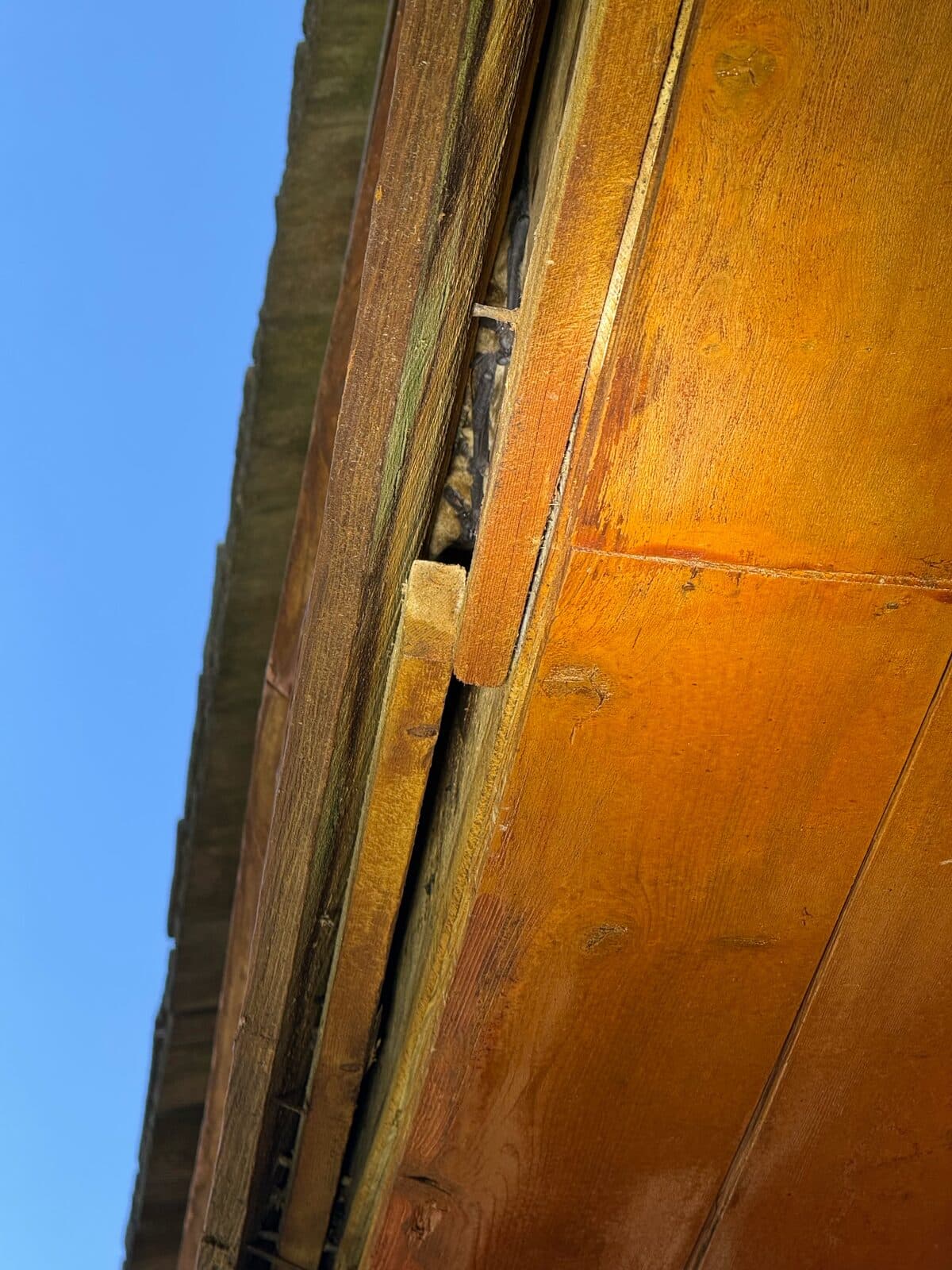
Why bats end up inside walls
Buildings give bats shelter, stable temperatures and a safe place to raise young, BCI says, and the voids inside exterior walls are a favorite. Bats get in from the outside, not through the living space: UC IPM lists the usual entry points as beneath eaves, around chimneys, around air and plumbing vents, near loose boards and beneath roof caps, and says bats can squeeze through openings as small as about 1/4 inch. In Southern California homes we most often trace wall colonies to gaps where fascia or trim meets stucco, open rafter bays that connect to the top of a wall, siding and trim joints on older wood homes, stucco weep screeds and the seams where a room addition meets the original house. Mexican free-tailed and big brown bats, two of the species UC IPM says most often use buildings in California, are the usual wall tenants.
Bats or rodents? How to tell what's in the wall
Timing is the best clue. Bats leave to feed around dusk and come back before dawn, so scratching, rustling or high-pitched chirping that peaks around sunset and again near sunrise points to bats; noise that continues through the night, or gnawing sounds, points more to rats or mice. Go outside at dusk and watch the wall: bats emerge one or a few at a time from a single gap. Then look at the droppings. UC IPM says bat droppings crush easily into powder with shiny bits of undigested insects, while mouse droppings lack the shiny bits and bird droppings are white and chalky. Don't crush them with bare hands; use a stick or a gloved hand, and don't stir up dust. If you can't tell, an inspection can.
Signs of bats in a wall
UC IPM says a bat entry point is often marked by dark staining from body oils, urine and droppings, much like rodent rub marks, and that off odors or droppings piled beneath an opening can help you find the roost. Look for small dark droppings collecting on a windowsill, on the ground or stuck to the siding below a gap, brownish smudges around a crack, an ammonia smell that is strongest on warm afternoons, and noise in the same section of wall every evening. A single bat flying inside the house is a different situation: BCI says a lone bat indoors is usually there by accident and doesn't necessarily mean a colony lives in the building, though L.A. County says finding a bat in your home can mean others are living in the attic. Our signs-of-bats guide, linked below, covers the full checklist.
Do not seal the hole or spray foam into the wall
It is tempting to fill the gap the bats use, but closing an occupied opening traps them inside the wall. BCI warns that closing exterior openings can be fatal to roosting bats and should never be done without a plan to prevent entrapment, that expanding foam should never be used in cracks where bats are active because they can get caught in it, and that dead bats have been found entombed in foam. Trapped bats do not stay quiet: BCI says signs that they have died of dehydration and starvation include strong putrid odors and dark stains on interior walls or ceilings from decomposing bats. UC IPM says excluding parents while young are inside also starves the pups and creates odor and fly problems. Bats are protected, and L.A. County Public Health notes it is illegal to kill them, so the only safe sequence is one-way exclusion first, permanent sealing second. That is also why we seal with custom-fitted inserts, screen, flashing and appropriate sealants, not spray foam.
Ultrasonic devices and repellents don't work
UC IPM says all ultrasonic sound generators that have been tested have proven ineffective for repelling bats, and BCI notes one study found ultrasonic devices may even attract them. UC IPM also says no pesticides or chemical repellents are registered in California for controlling bats or repelling them from roosts. Mothballs, sprays and noise only waste time while the colony stays in the wall.
What you can safely do right now
Close the inside, not the outside. BCI says interior access can be blocked without disturbing the colony by sealing openings around plumbing and gas pipes, electrical wiring and heating and air-conditioning units in utility closets, cabinets, behind appliances and under sinks, and by putting draft guards under attic doors. That keeps bats out of the rooms where people sleep. Never handle a bat: UC IPM says never handle bats or breathe dust from their droppings, and the CDC says histoplasmosis comes from breathing in fungal spores that grow in soil contaminated with bird or bat droppings. If a bat gets into the living space and may have touched anyone, including a sleeping person, a child or a pet, don't release it. Confine it and call your local animal control. In L.A. County, call Veterinary Public Health at 213-288-7060 (weekdays; 213-240-7941 after hours) about a possible exposure. Our bat-in-the-house guide, linked below, walks through each step.
How bats are removed from walls, and when
A professional exclusion starts with a full inspection to find every opening, because a wall colony often has more than one way in. Secondary gaps are sealed, and one-way devices (tubes, cones or netting) go over the main exits so bats can leave at night but not get back in. UC IPM says to leave netting or exit tubes in place for 7 days to make sure no bats are trapped before making permanent repairs; we then close every gap and confirm the wall is quiet. Timing matters: UC IPM says to avoid excluding colonies when flightless young could be present, usually May through September in California, and L.A. County Public Health says late fall and winter are the best time to bat-proof a home. If droppings or odor have built up inside the wall cavity, cleanup or opening a section of wall may be needed, which wescope separately after the bats are out.
Ready for help in Los Angeles, San Diego, or elsewhere in Southern California? Start with bat removal or an attic inspection.
Sources
- UC IPM Pest Notes: Bats
- Bat Conservation International: Bats in Homes & Buildings
- L.A. County Veterinary Public Health: Bats in Los Angeles County
- L.A. County Public Health: Health Advisory, Significant Increase in Rabid Bats (Sept. 4, 2026; updated Oct. 22, 2026)
- California Department of Fish and Wildlife: Human-Wildlife Conflicts, Bats
- CDC: Preventing Rabies from Bats
- CDC: About Histoplasmosis
- SEAACA: Wildlife
- OC Animal Care: Bats flyer